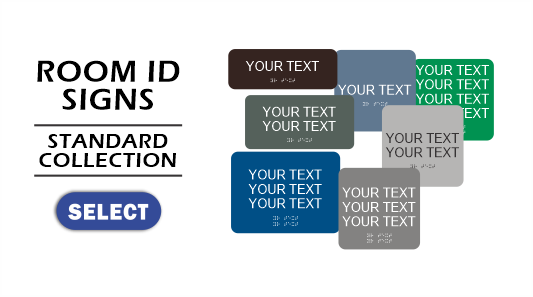
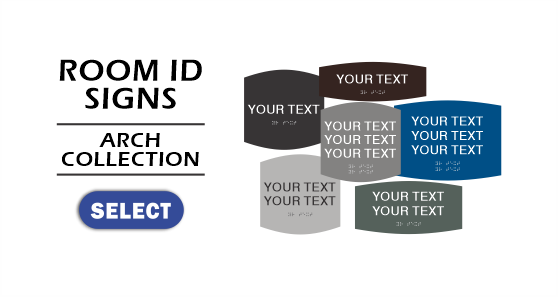
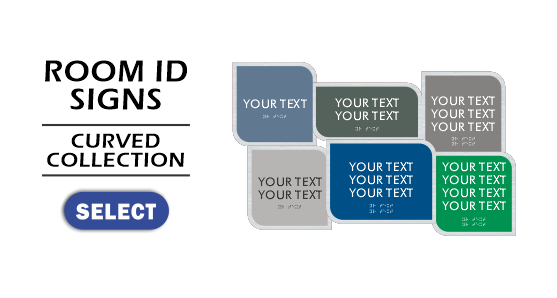
Braille Sign Pros can help you create customized ADA compliant braille room ID signs. Our ADA compliant braille office signs make it easy to outfit your entire facility with uniform signage. Choose from one to four lines of custom text, shapes, sizes, background colors, and border colors to match your building.
From hotel room number signs to room ID signs in corporate offices, shopping centers, hospitals and other public facilities; braille room ID signs from Braille Sign Pros not only help your customers find what they are looking for, but they also keep you and your business up to date on ADA regulations. Stay up to date and compliant with ADA signs that best suit your facility. Contact us today if you have questions about ADA compliant braille office signs. We are here to help you!
Every one of our custom room identification signs is engineered to keep your facility compliant, accessible, and professional from the first install to the thousandth. Whether you're numbering guest rooms in a hotel, labeling patient rooms in a hospital wing, or identifying offices, conference rooms, and suites across a corporate complex, our custom room ID signs pair raised tactile characters with Grade 2 Braille so visitors of every ability can navigate independently. Choose from a wide range of ADA-approved colors, finishes, and sizes to match your interior design while meeting federal requirements for character height, non-glare surfaces, and high-contrast readability. Each sign is American-made by a team with over 20 years in the ADA sign industry, built to withstand the wear of high-traffic environments and backed by quantity discounts that make outfitting an entire property cost-effective. Personalize your text with room numbers, names, or a serialized numbering system, and we'll handle the technical compliance details so your room identification signage is accurate, durable, and inspection-ready.
Room ID Signs FAQ
An ADA room identification sign is a tactile sign that labels a permanent room or space, such as a hotel guest room, hospital room, office, restroom, or storage area, in a way that's accessible to people who are blind or have low vision. To qualify as ADA-compliant, the sign must include raised (tactile) characters and Grade 2 Braille, use a sans-serif font, maintain proper color contrast, and have a non-glare finish. The ADA Standards for Accessible Design (Section 703) require these signs anywhere a permanent room or space is identified in a public or commercial building, which is why they're standard in hotels, healthcare facilities, schools, and corporate offices.
Yes. Hotel guest room numbers identify permanent spaces, so they fall under ADA signage requirements. Exterior signs at motel and hotel rooms must be tactile when they're located at the door to the room they serve, the same standard that applies to interior corridors. A serialized room numbering system also makes navigation far more intuitive for guests, which is why custom room ID signs are popular across the hospitality industry. Outfitting an entire floor or property is straightforward with our customizable text and quantity discounts
Grade 2 Braille is the contracted form of Braille required for ADA-compliant signage in the United States. Unlike Grade 1 Braille, which translates letter-for-letter, Grade 2 uses standardized contractions for common words and letter combinations, making it the recognized standard for room and space identification. Using the correct Braille grade, with properly domed dots and correct cell spacing, is essential; an incorrect translation or improper dot formation makes a sign useless to Braille readers and can put your facility out of compliance. Every Braille Sign Pros sign uses fully compliant Grade 2 Braille.
ADA tactile characters must be raised a minimum of 1/32 inch above the sign surface so they can be read by touch, printed or engraved-only text doesn't qualify. Uppercase character height must fall between 5/8 inch and 2 inches, measured by the height of a capital letter. Characters must be sans-serif, uppercase, and free of decorative or script styling that's difficult to distinguish by touch. Braille dots are placed directly below the corresponding text. These specifications ensure the sign is legible both visually and tactilely, and we build every custom sign to these exact tolerances.
Placement is one of the most common sources of accidental non-compliance, so it's worth getting right:
Latch side of the door. Mount the sign on the wall adjacent to the latch (handle) side of the door, never on the door itself, since a moving door makes the sign hard to locate and read.
Within proximity of the door frame. Position the sign close to the door — generally within a few inches of the frame — so it's clearly associated with the room.
Correct height. Mount so the tactile characters sit within the ADA-required range (measured from the floor), keeping the sign reachable for wheelchair users and people of varying heights and below the 60-inch maximum.
Clear floor space. Maintain an 18-inch by 18-inch clear area centered on the tactile characters so a person can approach and read the Braille without obstruction from furniture or equipment.
For double doors, recessed entryways, or other tricky configurations, mount on the nearest adjacent wall to the latch side. We're happy to advise on placement for unusual layouts.
Absolutely: customization is the point of a custom room ID sign. You can specify any room number, room name, or combination (for example, "Room 204," "Conference Room B," or "Housekeeping"), and choose from a wide selection of ADA-approved colors and finishes to coordinate with your building's interior. The key is that color choices must preserve the required high contrast between characters and background and use a non-glare surface. We handle those compliance details automatically, so you get a sign that looks like part of your design scheme while still meeting federal standards.
Our room ID signs are made from durable, architectural-grade materials with a non-glare finish, engineered to hold up in high-traffic, 24/7 environments without fading, warping, or losing their tactile definition. The raised characters and Braille are an integral part of the sign rather than a surface print, which makes them tamper-resistant and long-lasting. Signs typically include strong adhesive backing for easy mounting on clean, dry surfaces.
Non-compliance carries real consequences. Beyond excluding visitors who rely on tactile and Braille signage, facilities that fail to install proper room identification signs can face federal fines and accessibility lawsuits. Compliance issues frequently surface during inspections or renovations, so it's far less costly to install correct signage from the start. Sourcing U.S.-made signs built to current ADA standards, rather than imports that may use incorrect Braille spacing, is one of the simplest ways to protect your facility.
When signs identify permanent spaces such as conference rooms, storage rooms, break rooms, or mechanical rooms, they must meet applicable ADA requirements for visual and tactile accessibility. These room identification signs need raised characters and corresponding Braille, helping employees and visitors locate the correct space.
ADA room identification signs label a permanent room or space and require tactile text and Braille. Directional signs, such as an arrow pointing toward conference rooms, generally need to meet visual accessibility requirements but do not require raised lettering or Braille. A facility may use both to support accessible navigation.
Pictograms are generally optional for room identification signs. When a pictogram identifies a permanent room, it must appear within a field at least six inches high, with a descriptive label in raised text and Braille directly below. The pictogram itself does not need to be raised.
Prepare a complete list of room names and numbers, confirm spelling, and decide whether each sign needs a number, a name, or both. For a coordinated facility, choose consistent sign shapes, sizes, and colors. Braille Sign Pros offers custom room identification signs with one to four lines of text to accommodate different room labels.